
Some cities ask for a checklist. Porto asks for your attention.
The porto vibes people remember are rarely the loud moments. They stay with you in the sound of a metal shutter rising at breakfast time, in the steep walk that suddenly opens to a church façade, in laundry moving lightly above a courtyard, in the pause before your coffee arrives at a small counter where nobody is rushing you out. This is a city with texture. It rewards people who notice.
If you are the kind of traveler who wants to feel a place from the inside, Porto gives you plenty to work with. Not as a performance. Not as a packaged version of local life. Just as it is - layered, lived in, a little weathered, and deeply grounded.
What people really mean by porto vibes
When people talk about porto vibes, they often mean atmosphere, but that word can flatten things. Porto has atmosphere, yes, but it also has rhythm. The city moves with a certain restraint. Mornings begin quietly. Streets fill gradually. Conversations happen close to the ground - at bakery counters, on doorsteps, beside market stalls, in pocket-sized cafés where regulars know exactly what they want.
You'll notice that Porto does not reveal itself all at once. There are grand buildings, river views, and dramatic hills, but the feeling of the city often sits in smaller details. Worn stone steps. A narrow lane that smells faintly of bread. The mix of old workshop fronts and new independent stores. The way a residential street can turn a corner and become unexpectedly elegant.
That mix matters. Porto feels beautiful, but not polished into silence. There is still friction here, still evidence of work, routine, and ordinary life. That is part of the appeal.
Porto vibes start in residential streets
If you only experience Porto through major sightseeing routes, you will get one version of the city. It can still be lovely, but it may feel thinner than the real thing.
The deeper mood begins in residential neighborhoods, especially where daily life has not been pushed aside. In Bonfim and Campanhã, for example, the city breathes differently. You see people returning with groceries. You hear gates opening and scooters passing by. Small family-run businesses sit next to newer creative spaces without trying too hard to match each other. There is dignity in that coexistence.
This is also where Porto's scale becomes clear. It is a city you can walk through and read gradually. From Bolhão to quieter eastern streets, from busier avenues to tucked-away courtyards, the atmosphere changes block by block. A good day here is often shaped by transitions - market to garden, bakery to museum, uphill street to river light, afternoon quiet to evening tables filling up.
That is one reason many travelers end up preferring neighborhood stays over standard hotels. You are not stepping out into a lobby version of Porto. You are stepping directly into its cadence.
The architecture carries part of the mood
Porto's architecture does more than look good in photos. It shapes how the city feels to move through.
The hills create pauses and viewpoints without planning them. Granite gives weight to even simple buildings. Tile adds softness and memory. Courtyards and narrow passages create moments of enclosure before the city opens again. Even modest homes can carry small marks of care - painted trim, patterned stone, potted plants near a doorway, a bench placed in the shade at just the right angle.
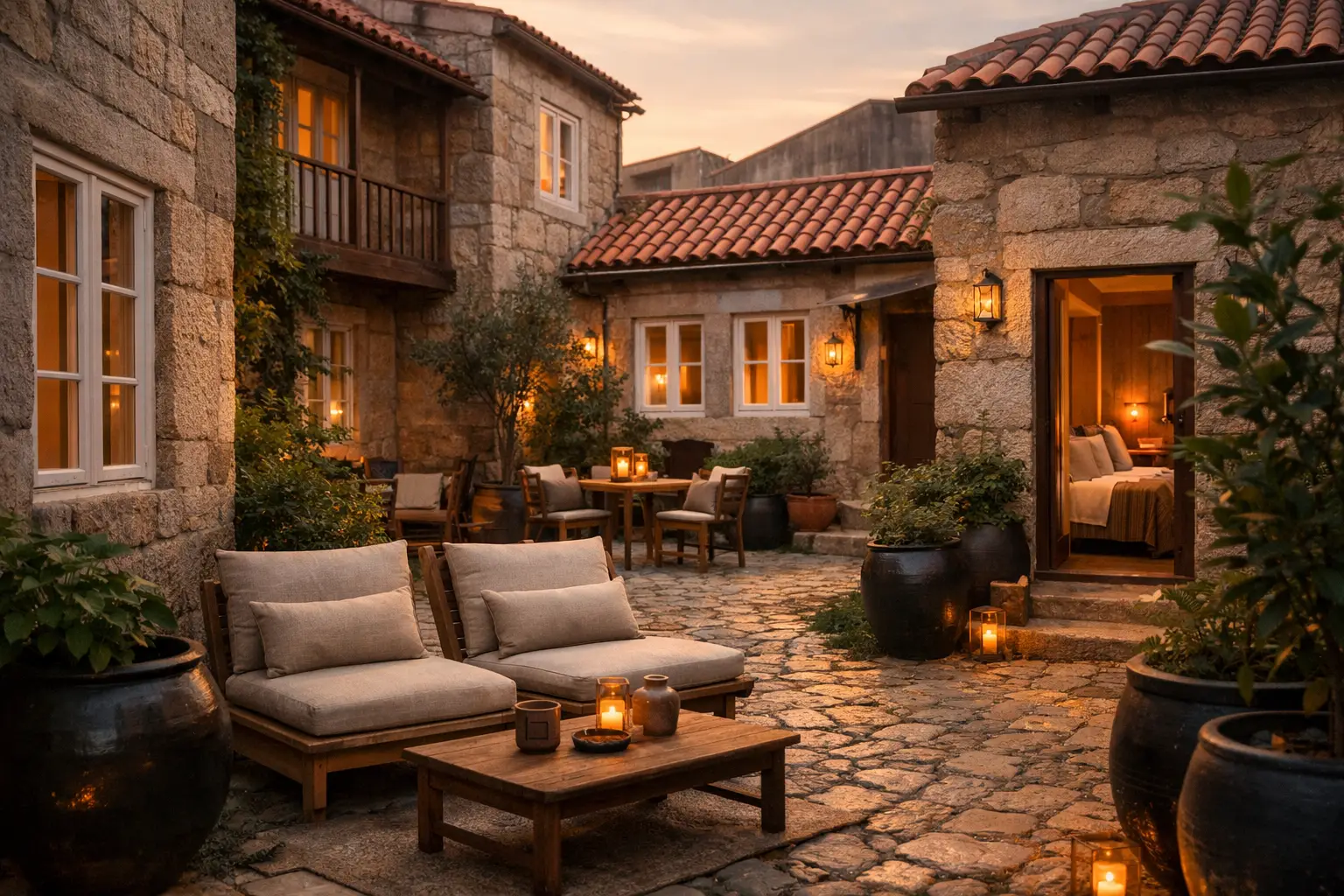
One of the most distinctive parts of Porto's urban story is the ilha - a courtyard community of small houses built behind the main street fronts. These spaces were historically working-class housing, and they still tell the truth about how much of the city was built around labor, proximity, and shared routines. Staying in a restored ilha can change your understanding of Porto entirely. You do not just admire heritage from the outside. You wake up inside a form of it.
There is a balance to get right, of course. Heritage should not be turned into a stage set. The best restoration keeps the texture and dignity of these places while making them genuinely comfortable to live in for a few days. That means warmth, quiet, good beds, practical kitchens, clear hospitality, and respect for the neighbors whose lives continue there.
Food is part of porto vibes, but not in the obvious way
A city's mood often shows up at the table. In Porto, that usually means simplicity done with confidence.
The meals you remember may not be the most elaborate ones. They might be the roast chicken from a neighborhood spot with paper placemats, the soup that arrives first without ceremony, the pastry eaten standing up, or the glass of wine poured in a place where the lighting is slightly too bright and the food is excellent. Porto can be generous without being performative.
There is also a certain honesty to how people eat here. Lunch can still feel like lunch. Coffee is quick but not careless. Bakeries are part of daily structure, not a lifestyle accessory. If you want to catch the city's actual flavor, it helps to leave room for repetition. Go back to the same café. Learn the timing of your street. Notice where people stop on their way home.
That kind of attention creates a more faithful travel memory than racing between reservations.
Why porto vibes feel different at night
Evenings in Porto can be lively, but the city's charm is not built on noise. It comes from the shift in pace.
At dusk, stone surfaces soften. Windows glow. Conversations stretch a little longer. In some streets, you will feel the city narrow into intimacy. In others, you get openness and air. A walk from Cedofeita toward the old center feels different from a slow evening in Bonfim, and that difference is part of what makes Porto satisfying. It is not one-note.
If you are looking for party energy, you can find it. But many travelers who connect with Porto most deeply are after something else - a city that still allows for quiet after dinner, a sense of return, a place where going home for the night feels like reentering the neighborhood rather than exiting the real city.
That is especially true if you are staying somewhere small-scale. A house within a residential setting changes the end of the day. You come back through a gate, hear the courtyard settle, and feel the distance between tourism and daily life narrow in a healthy way.
How to find porto vibes without forcing them
The mistake many visitors make is trying to collect Porto too quickly. This city does not respond well to over-scheduling.
Walk more than you think you need to. Let one errand lead to another. Keep one museum, one long meal, and one unplanned hour in the same day. Choose a neighborhood café over a concept place once in a while. Pay attention to the route back to where you are staying. Often that route becomes the real trip.
It also helps to choose accommodation that supports this slower way of seeing. Not because amenities do not matter - they do - but because atmosphere begins where you sleep. A generic room can make the city feel interchangeable. A well-kept home in a lived-in part of Porto gives context to everything else. At Ruby Charm Houses, for example, the experience begins inside a restored ilha community, where heritage, privacy, and neighborhood life meet in a more personal way than a standard hotel stay can usually offer.
Still, authenticity is not a product you can buy by the night. It depends on how you move. Greet people. Keep your voice down in shared spaces. Notice that someone lives next door. Treat the street as part of a neighborhood before you treat it as a backdrop.
That is when Porto tends to open up.
The porto vibes worth taking home
The most lasting porto vibes are not dramatic. They are steady.
They live in the confidence of a city that does not need to explain itself at every turn. In the beauty of places made for use, not display. In the closeness between home, street, shop, and square. In the feeling that history here is not sealed behind glass. It is still being cared for, adapted, and lived with.
If Porto gets under your skin, it is usually because of that balance. The city has soul, yes, but also structure. Warmth, but also reserve. Beauty, but with real edges. You do not have to chase a perfect version of it. You'll feel more if you let the ordinary parts count.
Start there. A morning coffee. A walk through Bonfim. A quiet courtyard. A street you take twice because it felt right the first time. That is often enough.